
Recommended ingredients for facial antiperspirants
Aluminum chlorohydrate
When choosing a facial antiperspirant, be sure to pay attention to the ingredients.
Many deodorants for underarm odor contain primarily antibacterial and antiseptic ingredients, but for facial use, there is no need to choose one with ingredients that are specifically antiseptic.
Antiperspirants and deodorants have different uses: deodorants act against odors or have antibacterial or antiseptic properties, while antiperspirants are designed to suppress sweating.
If the product does not contain antiperspirant ingredients, sweating will not stop, so if you want to deal with facial sweating, be sure to choose a product that contains antiperspirant ingredients.
Also, even if the product contains antiperspirant ingredients, they can be dangerous depending on the amount contained, so choose an antiperspirant that is relatively gentle on the skin and not too harsh, or one that is clearly labeled for use on the face.
Recommended ingredients for facial antiperspirants
Aluminum chlorohydrate
Aluminum chlorohydrate is a mainstream ingredient in antiperspirants, used in a huge number of products and relatively gentle on the skin.
An improved version of aluminum chloride, it has a strong astringent effect and forms a hydroxide gel in the sweat ducts in the epidermis, blocking the sweat glands and reducing sweating.
Even if two antiperspirants contain the same aluminum chlorohydrate, there can be differences in effectiveness between products, largely due to the amount contained and the other ingredients used.
For facial use, choose a product that contains a relatively low amount of aluminum chlorohydrate, is less irritating to the skin, and contains skin-beautifying ingredients.
Zinc paraphenolsulfonate
Zinc paraphenolsulfonate is also a common ingredient in antiperspirants.
It adsorbs sweat, changes proteins to provide an astringent effect, and forms a film.
While its antiperspirant effect is inferior to that of aluminum chlorohydrate, it is a relatively mild ingredient that can be used.
Burnt alum (potassium aluminum sulfate)
Alum is potassium aluminum sulfate, and when it is dried it is called burnt alum.
Alum is also an ingredient used in cooking, so it is highly safe to apply to the skin.
Burnt alum has an astringent effect, constricting sebum and sweat glands to reduce sweating.
Although its astringent and antiperspirant properties are inferior to those of the two ingredients mentioned above, it has long been used as an antiperspirant.
However, just like other ingredients, it can be dangerous if it gets into your eyes, so rinse it thoroughly with water and consult a doctor if you experience any discomfort.
Ingredients to avoid
aluminum chloride
Aluminum chloride is a highly irritating ingredient, and many people experience itching even when using it under the arms.
Even when used to apply to the underarms, it can cause redness or irritant dermatitis, making it unsuitable for many people, and if it does not suit your skin, it can be difficult to use continuously.
It can be very dangerous if it gets into your eyes, so be sure to avoid using it as a facial antiperspirant.
Recommended type of facial antiperspirant
Cream-type antiperspirant
Cream-type antiperspirants are the most common type of facial antiperspirant.
Their unique feature is that you can adjust the amount you use and apply it to only the areas of concern, allowing you to tailor it to your needs.
Cream-type facial antiperspirants are especially recommended as they blend easily into the skin and are easy to carry around with you.
There are many different types of cream antiperspirants, but as mentioned at the beginning, creams that are only intended as deodorants will not stop sweating, so be sure to choose a cream type that also contains antiperspirant ingredients.
Sheet-type antiperspirant
Compared to other products, sheet-type products do not have the antiperspirant effect, and even if they contain antiperspirant ingredients, they do not contain very high amounts.
You may feel that they are not effective enough to be used as an antiperspirant, but they are a very useful type to use on your face, as they can wipe away sweat every time and keep your skin clean.
Additionally, many sheet-type products contain ingredients such as menthol, which can provide a cooling effect and make you feel refreshed and cool, making them an essential item for the summer and becoming increasingly popular in recent years.
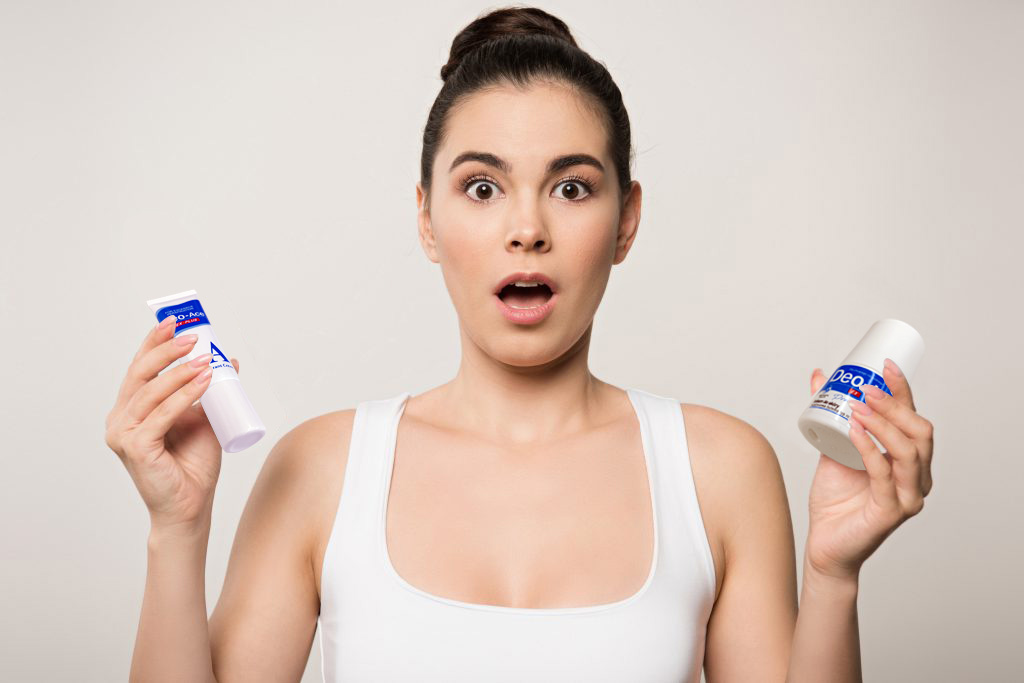
Is it okay to apply DeoAce to my face?
We do not recommend applying the roll-on type to the face.
This is because roll-on types contain a high amount of aluminum chlorohydrate, which makes them very effective at stopping sweat, but aluminum chlorohydrate has a strong astringent effect, so care must be taken when using it on the eyes or mucous membranes.
For example, even if the product does not get into your eyes when applied to your forehead, there is a risk that the ingredients may get into your eyes due to sweat. We ask that you refrain from using roll-on types on your face.
Also, if it does get into your eyes, rinse with plenty of water for 10 to 15 minutes.
If you experience any discomfort in your eyes after that, see an ophthalmologist immediately.
It can also be applied to your hands, feet, chest, back, etc.
DeoAce medicated cream for the face
DeoAce Medicated Cream also contains aluminum chlorhydrate, but the amount is lower than in the roll-on cream, making it suitable for application to the face.
It also contains no synthetic fragrances, colorings, or alcohol, making it effective for treating full-body sweat for those with sensitive skin.
It also contains beauty ingredients, so it can provide skin care and antiperspirant benefits at the same time.
If you want to use an antiperspirant on your face, we recommend a medicated cream rather than a roll-on type.
However, it is not completely safe if it gets in your eyes, so if it does get in your eyes, rinse it immediately with water and, as with roll-on types, see an ophthalmologist if you experience any discomfort.